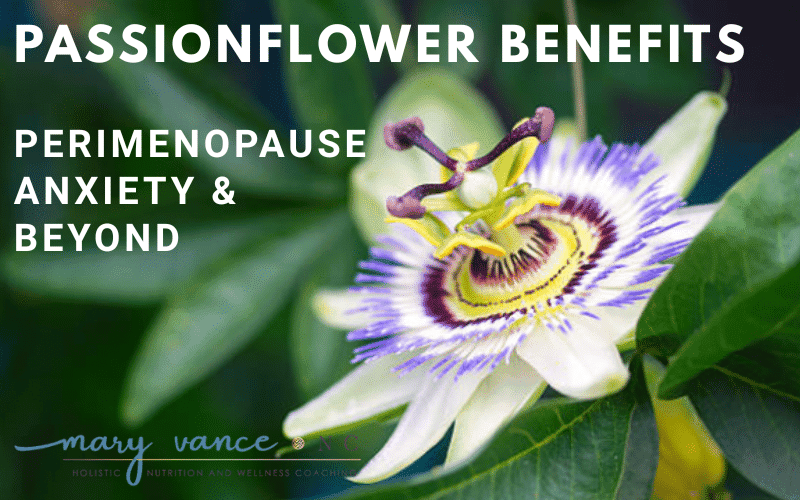
photo credit: Anna Dudek
I’ve been recommending passionflower extract to my peri- and menopausal clients for years with consistently good results. I’ve even recently started using it myself lately and been doing a deeper dive on its therapeutic use. Passionflower has great benefits for mid-life women and beyond: It is also useful for anxiety, insomnia, and nervous system support.
As I’ve shifted my practice further to address perimenopause, I’ve noticed this life transition has a way of sneaking up on you. It’s not always missed periods or obvious hormonal shifts but something a but more obscure.
You feel more anxious, but nothing in your life has necessarily changed. Your sleep gets lighter and more fragmented.
You may feel exhausted yet wired. (I hear this SO frequently). Small stressors feel bigger. Your patience is thinner. You feel more reactive.
For many women, this phase isn’t just about hormones; it’s about the nervous system becoming more sensitive to these hormonal fluctuations, and your symptoms are a direct reflection of that.
So this is where our plant allies can make a meaningful difference.
Passionflower (Passiflora incarnata) is a calming botanical traditionally used to support the nervous system. It looks exotic and delicate (it’s such a beautiful flower), but it’s one of the most effective herbs for quieting an overactive mind and body.
Historically used for anxiety, insomnia, and restlessness, passionflower is now gaining attention for its role in hormonal transitions, especially perimenopause and menopause. I think this is an underutilized herb with so many benefits.
What is Passionflower?
Passionflower (Passiflora incarnata) is a climbing vine with intricate, almost otherworldly flowers, but its real power lies in how it interacts with the nervous system.
Passionflower is a nervine, an herb that supports and regulates the nervous system. I am big fans of these guys for their calming and regulating effects. As someone who has struggled periodically with anxiety, I myself have relied on this class of botanicals throughout the years.
Passionflower is not sedating in a heavy, knock-you-out way. Instead, it works more subtly:
- It quiets mental chatter
- Eases physical tension
- Helps the body shift out of a stress state
Its gentle “volume lowering” effect can incredibly valuable for mid-life hormonal shifts.
Perimenopause & the Nervous System
Let’s look more deeply into the intersection of nervines and nervous system impact for perimenopause and menopause.
Mid-life hormonal shifts are often framed as a hormonal issue, specifically relative to estrogen.
As estrogen fluctuates within your cycle, it affects:
- Serotonin → mood stability
- GABA → relaxation and calm
- Cortisol → stress response
- Sleep architecture → how deeply you rest
These fluctuations are intense during perimenopause and can manifest as the following:
- Increased anxiety or irritability
- More frequent night waking
- Heightened stress sensitivity
- That classic “tired but wired” feeling
Your nervous system has less buffering capacity during this phase.
So instead of asking, how do I fix my hormones, a more useful question becomes, how can I support a nervous system that’s navigating hormonal change? This in ADDITION to supporting hormone balance.
That’s where passionflower comes in.
How Passionflower Works
Passionflower’s primary mechanism involves GABA, a calming neurotransmitter in the brain.
GABA (gamma-aminobutyric acid) acts like a brake pedal in the nervous system. It slows down neuronal firing and helps you shift into a more relaxed, parasympathetic state.
Passionflower has been shown to:
- Increase GABA availability
- Reduce over-excitation in the brain
- Promote a sense of calm without impairing cognition
This makes it especially helpful for women who don’t just feel stressed but also internally activated and unable to settle.
Passionflower Benefits
Passionflower’s calming effects are not just anecdotal. Clinical research suggests it interacts with the GABA system helping to reduce neuronal excitability and promote relaxation. In a randomized controlled trial, passionflower was found to be as effective as the pharmaceutical anti-anxiety medication oxazepam, with fewer side effects (Akhondzadeh et al., 2001). Additional studies, including double-blind placebo-controlled trials, have demonstrated improvements in sleep quality, particularly in individuals experiencing mild sleep disturbances (Ngan & Conduit, 2011). Systematic reviews further support its use, showing consistent reductions in anxiety across multiple clinical trials.
1. It takes the edge off anxiety without that dulling effect that pharmaceutical drugs may cause. In a randomized controlled trial, passionflower was found to be as effective as a conventional anti-anxiety medication (oxazepam), with fewer cognitive side effects.
One of the most common shifts in perimenopause is a kind of low-grade, persistent anxiety that may not always tied to thoughts. Anxiety also has physical manifestations like tension and muscle soreness.
Passionflower helps by
- Reducing that edgy feeling
- Softening emotional reactivity
- Creating a buffer between stimulus and response
It doesn’t flatten your mood or sedate you into numbness; rather, it simply stabilizes your nervous system.
2. It supports deeper, more restorative sleep.
Recent clinical trials continue to show improvements in both stress and sleep outcomes with passionflower extract.
Sleep disruption is often one of the earliest and most frustrating symptoms of perimenopause.
You may find that you:
- Struggle to fall asleep because your mind won’t slow down
- Wake up between 2–4am and can’t fall back asleep
- Feel unrefreshed even after a full night in bed
Passionflower can help by:
- Calming pre-sleep mental activity
- Supporting smoother transitions into sleep
- Reducing nighttime awakenings driven by stress hormones
It’s particularly helpful for women whose sleep issues feel nervous system driven rather than purely hormonal.
Check out my perimenopause sleep guide for more support.
3. It improves stress resilience over time.
Chronic stress and perimenopause are a difficult combination. As your hormonal buffering decreases, your ability to tolerate stress often decreases with it.
Passionflower doesn’t eliminate stress, but it can
- Reduce the intensity of your stress response
- Help you recover more quickly after activation
- Support a more regulated baseline over time
This matters, because elevated cortisol can further disrupt
- Sleep
- Blood sugar
- Hormonal balance
So while passionflower isn’t “balancing hormones” directly, it’s supporting one of the systems that most impacts them.
4. It may help reduce hot flash intensity
Hot flashes are often framed as purely hormonal, but the nervous system plays a role here, too.
Stress and sympathetic activation can
- Trigger or worsen hot flashes
- Increase their perceived intensity
- Make them feel more disruptive
By calming the nervous system, passionflower may
- Reduce stress-triggered episodes
- Improve your tolerance to temperature shifts
- Decrease the overall “intensity” of the experience
It’s not a direct replacement for hormone therapy, but it can be a meaningful support alongside it.
5. It helps with the “wired but exhausted” state.
This is one of the most common and frustrating experiences I see with my perimenopause clients.
You’re tired all day, but when you finally have a chance to rest, your body won’t cooperate. Maybe your mind races, you feel too alert (when you don’t want to!), and sleep doesn’t come easily. I know all too well that feeling of sheer exhaustion when you get into bed at night but your body won’t let you drift into restful sleep.
This is a classic sign of nervous system dysregulation.
Passionflower helps bridge that gap by:
- Gently downshifting the nervous system
- Making it easier to transition into rest
- Reducing the mismatch between mental and physical states
Why Passionflower Tincture Works So Well
While passionflower can be taken as a tea or capsule, tinctures offer some unique advantages:
- Fast-acting: absorbed quickly, often felt within 15–30 minutes
- Flexible dosing: easy to adjust based on need
- Convenient: can be used situationally (not just daily)
I like and use this one, 2-3 droppers as needed. It’s especially useful taken for the 3am wakeups and anxiety spikes and can help you get back to sleep. Keep it on your nightstand!
It should be a part of your pre-bed routine. Think of it less like a supplement you take every day and more like a tool you can reach for in real time.
How to Use Passionflower Tincture
General guidelines:
- Daily nervous system support: 1–2 droppers in water or directly on the tongue, 1–2x per day
- Sleep support: Take 30–60 minutes before bed and as needed during the night
- Acute stress or anxiety: Use as needed
Start low, especially if you’re sensitive, and increase gradually. Some people feel effects quickly. For others, it becomes more noticeable with consistent use.
Who Should Use Caution
Passionflower is generally well-tolerated, but there are a few considerations:
- It may enhance the effects of sedatives or anti-anxiety medications
- Avoid combining with alcohol
- Consult your practitioner if pregnant, breastfeeding, or on medications
As always, more is not better. The goal is gentle regulation, not sedation.
Beyond Menopause
While it’s especially helpful during hormonal transitions, passionflower’s benefits extend well beyond this phase of life.
It can be supportive for the following:
- Chronic stress and burnout
- High-functioning anxiety
- Sleep disturbances unrelated to hormones
- Periods of emotional overwhelm or life transition
In many ways, it’s less of a “menopause herb” and more of a nervous system herb. Because the reality is most people today are operating in a low-grade state of activation. Over time, that takes a toll.
Conclusion
It’s easy to look for a single solution during perimenopause: Something to “fix” what feels off. But this phase is less about fixing, and more about supporting adaptation.
Your body is changing. Your nervous system is recalibrating. Your capacity for stress may be different than it was before.
Passionflower doesn’t override that process nor does it force your body into balance. It creates the conditions where your system can feel safe enough to regulate again. And that’s where the real shift happens.
If perimenopause feels like your internal volume has been turned up, passionflower helps turn the dial down just enough for you to feel like yourself again. Not sedated, just steadier.
Passionflower alone is great, or alongside HRT is a powerful combo to address both hormonal fluctuations and nervous system support.
Have you tried passionflower, and how has it helped you?
Frequently Asked Questions About Passionflower
What is passionflower?
Passionflower (Passiflora incarnata) is a medicinal plant traditionally used to promote relaxation, reduce anxiety, and support restful sleep. Today, it’s one of the most commonly used herbal remedies for nervous system support.
Can passionflower help with perimenopause and menopause?
It may. Passionflower doesn’t replace declining estrogen, but it may help ease some of the symptoms that often accompany perimenopause and menopause, including anxiety, irritability, poor sleep, and nighttime restlessness.
Is passionflower good for anxiety?
Research suggests that passionflower may help reduce mild to moderate anxiety by supporting the GABA neurotransmitter system, which promotes calmness and relaxation. Many people find it helpful during periods of increased stress or hormonal fluctuations.
Can passionflower improve sleep?
Yes. Passionflower is commonly used to support falling asleep more easily and improving sleep quality, particularly when racing thoughts, stress, or anxiety are contributing to insomnia.
Does passionflower increase estrogen?
No. Passionflower is not considered a phytoestrogen and does not increase estrogen levels. Its benefits are primarily related to its calming effects on the nervous system rather than directly influencing hormone production.
Is passionflower safe to take every day?
For most healthy adults, passionflower is generally considered safe when used as directed for short- to medium-term use. As with any supplement, it’s important to discuss it with your healthcare provider, especially if you’re pregnant, breastfeeding, taking sedatives, or using medications for anxiety or depression.
Can I take passionflower with hormone replacement therapy (HRT)?
In most cases, passionflower can be used alongside hormone replacement therapy because it works through different mechanisms. However, you should always discuss supplements with your healthcare provider to ensure they’re appropriate for your individual health history and medications.
Who should avoid passionflower?
Passionflower may not be appropriate for people who are pregnant, taking sedative medications, or using certain antidepressants or anti-anxiety medications. Because it can have calming effects, it may also increase drowsiness when combined with alcohol or other sleep aids.
 Welcome to my site! I am a holistic nutrition consultant based in California, though I work with clients all over the world. I love houseplants, dogs, snow sports, and music that doesn't suck.